
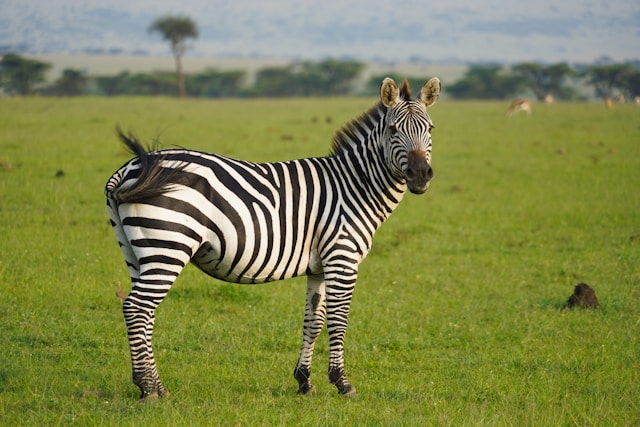
Yet despite its potential to benefit people and wildlife, movement ecology is not fully reflected in the tools and targets that guide conservation decisions like the Kunming-Montreal Global Biodiversity Framework or the UN Sustainable Development Goals. Addressing this challenge is the focus of a new paper in Proceedings of the Royal Society B, first authored by Talia Speaker, executive manager of WILDLABS at WWF: “Emerging innovations in movement ecology to address planetary challenges.”
Here are five ways animal movement data can and should inform better conservation decisions for the benefit of both people and wildlife:
1. Movement data reveals what animals need
Animals move around for many reasons—to find food, drink water, mate, migrate…and more. These movements can vary by season, life stage, and the condition of the surrounding habitat. To understand these patterns, scientists can use a host of tools, including GPS tags and collars, satellite tags, radio or acoustic tags, or even light-level geolocators, depending on the species and its environment.
The resulting movement data reveal where, when, and why animals move, making it possible for conservationists to identify critical habitat, migration routes, stopover sites, and corridors that would otherwise be missed. In conservation practice, these data help decision-makers determine which places need protection, restoration, or reduced disturbance.
2. Movement data makes connectivity measurable
Human infrastructure such as roads, fences, and settlements can make it difficult for animals to move between habitats. Many species rely on movement between locations to feed, breed, and access seasonal resources, so barriers can affect not only individual survival but entire populations.
Even when habitats fall within protected areas, they may not be functionally connected, limiting the effectiveness of those protections. By tracking animals as they move across landscapes, scientists can determine whether protected areas are truly connected and identify critical movement corridors that are just as important as the habitats themselves.
3. Movement data can warn us if populations are struggling
Changes in movement behavior, dispersal, home range use, or migration can show that animals are under stress before population declines are obvious. These changes in movement patterns may be due to habitat loss, climate change, human disturbance, disease, or resource shifts. By tracking animal movements over long periods of time, conservationists can identify the problem and intervene earlier, when actions are still more effective and less costly.